

Many families first begin thinking about Medicare and Medicaid after a serious diagnosis, a sudden fall, or a loved one’s unexpected move into a care facility. While it seems logical to assume Medicare will handle care costs, that assumption is actually one of the most expensive mistakes a family can make.
When it comes to paying for care for yourself, your parent, your spouse, or another senior loved one, it’s important to understand that Medicare and Medicaid are not interchangeable. Confusing the two programs can bring serious financial consequences. This article aims to help you understand the differences between Medicare and Medicaid, and how to move forward with security, safety, and peace of mind for all parties involved.
What Is Medicare?
Medicare is a federal program that supports the cost of healthcare for older Americans. Most people who are 65 or older qualify, and it is a program that many working Americans pay into through paycheck deductions over the course of their careers. The key trait that differentiates Medicare from Medicaid is that it is available regardless of a person’s income or assets — unlike Medicaid, which is means-tested.
Medicare coverage is split into four parts, detailed in the graphic below:
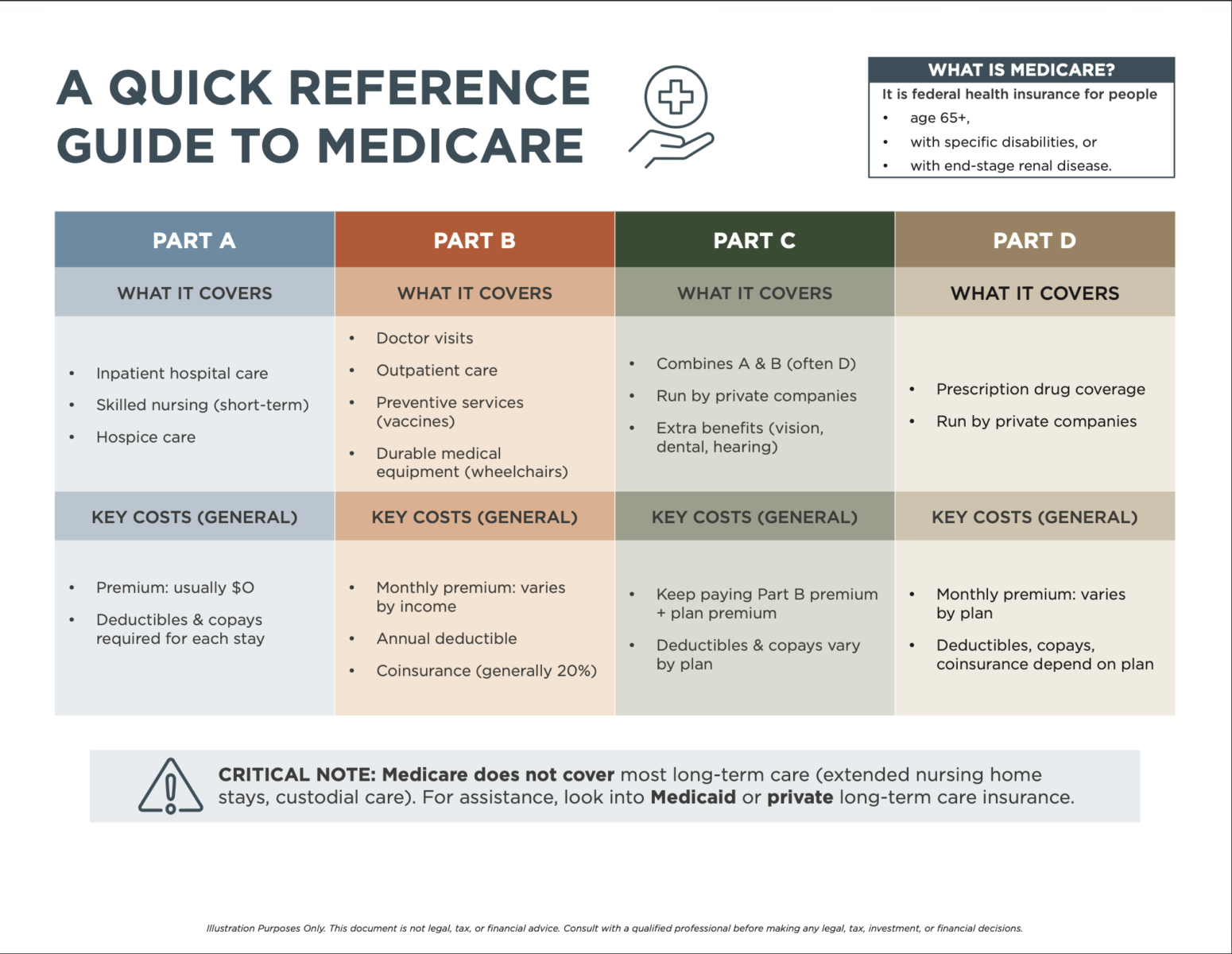
Infographic from Wealth Counsel
It’s also worth noting that Florida has one of the highest concentrations of Medicare Advantage (Part C) plans in the country, due to its large senior population. Medicare Advantage is a common and popular choice — not a last resort. However, network restrictions and prior authorization requirements are especially worth scrutinizing before enrolling, as your preferred doctors, specialists, and care facilities may not be covered under every plan. Before committing to a Medicare Advantage plan, confirm that your current providers are in-network and understand what approvals may be required before major procedures or treatments.
What Medicare Does Not Cover — The Most Important Thing to Know
Medicare Part A covers skilled nursing facility care only in the short term, up to 100 days with copays beginning after day 20. After that, Medicare stops covering those services entirely.
Despite this short-term coverage condition, many families believe that Medicare will cover custodial or long term care, whether in a nursing home, assisted living facility, memory care unit, or at home. This is where most families are blindsided.
| If you take nothing else away from this article, remember this: Medicare does not cover long term care.
What Is Medicaid?
Medicaid is a joint federal and state program, and both eligibility and benefits are shaped at the state level. Unlike Medicare—which is accessible to nearly anyone 65 or older—Medicaid is a means-tested program, meaning it can exclude people whose income or assets exceed a certain level. This makes the path to Medicaid eligibility a more complex process, and one that benefits significantly from early planning.
The most important distinction between Medicare and Medicaid is that Medicaid will cover long term care costs, including nursing home care, assisted living, memory care, and home and community-based services. Medicaid is the largest single payer for long term care in the country, and for many Florida families, it is ultimately what makes ongoing care financially sustainable.
The Basics of Medicaid Eligibility in Florida
Florida has multiple distinct Medicaid programs relevant to seniors. Most Florida Medicaid recipients are enrolled in the Statewide Medicaid Managed Care (SMMC) program, which is split into the Long-Term Care (LTC) program, the Managed Medical Assistance (MMA) program, and the Dental Program.
Key limits and requirements for 2026 include:
- Income Limit: $2,982 per month for individuals; $5,964 per month for married couples where both spouses are applying.
- Asset Limit: Generally, $2,000 in countable assets for an individual. (Note: your primary home and vehicle are typically excluded from this calculation.)
- Community Spouse Protections: If one spouse needs nursing home care, the spouse remaining at home is not left with nothing. Florida’s Community Spouse Resource Allowance allows the at-home spouse to retain between $32,532 and $162,660 in assets, plus a monthly income allowance to cover living expenses.
- Five-Year Look-Back Period: Medicaid reviews all financial transfers made in the 60 months prior to your application. Giving assets away (e.g. transferring money to your children) to meet the asset limit can trigger a penalty period during which you are ineligible for benefits.
- Estate Recovery: All states, including Florida, are required to seek reimbursement for Medicaid costs from a beneficiary’s estate after death. This can affect what you are able to leave behind for your family.
This is why planning early—ideally at least five years before you anticipate needing care—makes a significant difference. If you are trying to qualify for Medicaid in Florida, the right legal and financial strategies can help protect your assets, provide for your family, and establish a clear path to Medicaid eligibility when the time comes.
Don’t Wait for a Crisis. Plan Ahead to Stay Safe and Secure.
Financing long term medical care is one of the most stressful logistical challenges a family can face—especially when you are already in an emotional and vulnerable state during a difficult time.
You don’t have to figure this out alone, and you definitely don’t want to figure it out in a crisis. Whether you’re planning ahead or already navigating a care transition, understanding how Medicare and Medicaid work together—and where the gaps are—is the foundation of any solid long term care plan.
Learn more about how we help Florida families navigate long term care planning, and contact our office to get personalized legal assistance.